
Craft Room · Buying guide
Best Sewing Chairs: Pick by Seat Height, Not Hype
Six chairs checked on paper against your seat height: measure first, pick a range that fits, and add a footrest where it does not.
The short answer
Choose an armless, height-adjustable task chair whose seat range includes your seat height (about a quarter of your body height), with lumbar support and a rounded front edge. At a counter-height table, use a drafting chair with a foot ring.
Our picks at a glance
Best overall
Long sessions at a desk-height table, if you want every key adjustment in one chair.
See it at Amazon (opens in a new tab)Best chair made for sewing
Horn SEW COZY Standard Sewing Chair
Sewists who want a sewing-specific chair with more back and seat adjustment than a basic hydraulic chair.
Best sewing chair with storage
Arrow H7013B Hydraulic Sewing Chair
Taller sewists or high tables, and anyone who wants notions storage under the seat.
See it at Amazon (opens in a new tab)Best on glides
Supra Sewing Adjustable Tailoring Chair
Sewists whose chair rolls back every time they press the pedal.
Best for counter-height tables
Primy Armless Tall Drafting Chair
Sewing, cutting or quilting at a counter-height table or standing station.
See it at Amazon (opens in a new tab)Best second seat
JMU Saddle Stool with Adjustable Seat Tilt
Alternating with your regular chair at a counter-height table or raised machine.
See it at Amazon (opens in a new tab)
Which one is for you
| If you… | Buy… |
|---|---|
| sew for long sessions at a desk-height table | Steelcase Series 1 |
| want a chair made for sewing with seat-depth adjustment | Horn SEW COZY Standard |
| are about 6'0" or taller, or your table is high | Arrow H7013B |
| find your chair rolls away when you press the pedal | Supra Sewing Adjustable Tailoring Chair |
| work at a counter-height table | Primy Armless Tall Drafting Chair |
| want a second seat to change posture | JMU Saddle Stool |
01Best overall
Steelcase Series 1
Best for: Long sessions at a desk-height table, if you want every key adjustment in one chair.
The most adjustable pick: seat height, seat depth, lumbar height, recline and arms that drop to 23½ in from the floor. Its 16½ in low end matches the starting seat height for a 5'6" sewist.
- Seat height
- 16½–21½ in (42–55 cm)
- Arms
- 4D arms on the linked listing, 23½–32¼ in (60–82 cm) from the floor; armless version from the maker
- Lumbar
- Adjustable, 6½–8¾ in (17–22 cm) above the seat; seat depth 15¾–18 in (40–46 cm)
- Casters or glides
- Hard casters standard; soft casters or glides optional
- Weight capacity
- 400 lb (181 kg)
- Warranty
- Limited lifetime, 12 years on parts and labor
Why we like it
- Seat depth and lumbar height both adjust, the two settings that matter most for back comfort.
- The back reclines: the seat-to-back angle opens from 100° to 124° for breaks.
- Glides are an option if the chair drifts when you press the pedal.
Keep in mind
- The linked listing comes with arms; the armless version is sold through the maker's own channels.
- Under 5'6" your starting number sits below its 16½ in minimum, so plan on a footrest.
Skip it if your table is counter height; the stool version (seat 23–30¾ in, 58–78 cm) fits that better.
How we know: Maker product page and product cut sheet, linked in Sources. We did not sit in this chair.
02Best chair made for sewing
Horn SEW COZY Standard Sewing Chair
Best for: Sewists who want a sewing-specific chair with more back and seat adjustment than a basic hydraulic chair.
Made for standard-height sewing cabinets, with a 6 in backrest range, 2⅝ in of seat-depth travel and independent seat and back angles.
- Seat height
- 16¾–21¼ in (43–54 cm)
- Arms
- None on the standard version; a version with adjustable arms is offered
- Lumbar
- Adjustable with a lever; backrest height range 6 in (15 cm); seat depth travel 2⅝ in (7 cm)
- Casters or glides
- 60 mm casters
- Weight capacity
- Not stated on the maker page
- Warranty
- Not stated on the maker page
Why we like it
- Seat depth adjusts, so you can keep the 2–3 finger gap behind the knee.
- Back angle tilts 16° independently of the seat.
- Made in the USA, in four fabric colors.
Keep in mind
- The maker page lists the lowest seat as both 16¾ in and 16¼ in; ask the dealer.
- Sold through sewing dealers, so there is no store link here.
Skip it if you need a seat below about 16 in or a lower budget.
How we know: Maker product page, linked in Sources. We did not sit in this chair.
03Best sewing chair with storage
Arrow H7013B Hydraulic Sewing Chair
Best for: Taller sewists or high tables, and anyone who wants notions storage under the seat.
A classic armless sewing chair with lumbar support and a lift from 18 to 22 in. That low end matches the starting seat height for a 6'0" sewist.
- Seat height
- 18–22 in (46–56 cm)
- Arms
- None
- Lumbar
- Fixed lumbar support; backrest 10½ in (27 cm) above the seat
- Casters or glides
- Casters on a five-star swivel base
- Weight capacity
- 300 lb (136 kg) per maker spec sheet
- Warranty
- 1 year per maker spec sheet
Why we like it
- Armless, so it pulls close to the machine.
- 16 in seat depth stays under the 16.9 in limit the ANSI/HFES standard sets for fixed seats.
- Storage under the seat, 15½ × 13¼ × 2 in.
Keep in mind
- Short backrest, with no seat-depth or lumbar adjustment.
- Below about 6'0" the 18 in minimum sits above your starting number, so add a footrest.
Skip it if you sew for hours with back pain; a fully adjustable chair fits better.
How we know: Maker spec sheet (PDF, retailer-hosted) and the Amazon listing, both linked. The listing gives a lower 150 kg (330 lb) weight figure than the spec sheet. We did not sit in this chair.
04Best on glides
Supra Sewing Adjustable Tailoring Chair
Best for: Sewists whose chair rolls back every time they press the pedal.
An armless operator chair on floor glides instead of casters, with a 16–21 in seat and a backrest that slides up and down.
- Seat height
- 16–21 in (41–53 cm)
- Arms
- None
- Lumbar
- Height-adjustable backrest; seat 18 × 18 in (46 × 46 cm)
- Casters or glides
- Floor glides only; casters not offered
- Weight capacity
- Not stated by the seller
- Warranty
- Seller warranty, term not stated
Why we like it
- Glides match OSHA's sewing-station advice: no wheels, or wheels that lock.
- Lowest minimum height in this guide, 16 in.
Keep in mind
- No weight rating or warranty term published.
- Swivels but does not roll, so moving to the iron means standing up.
Skip it if you move between machine, cutting table and iron all day.
How we know: Seller product page with specifications, linked in Sources. We did not sit in this chair.
05Best for counter-height tables
Primy Armless Tall Drafting Chair
Best for: Sewing, cutting or quilting at a counter-height table or standing station.
A tall armless chair with a 22–30 in seat and an adjustable foot ring, so your feet stay supported when the seat goes up.
- Seat height
- 22–30 in (56–76 cm)
- Arms
- None
- Lumbar
- C-shaped mesh back, not adjustable
- Casters or glides
- Casters, plus a height-adjustable foot ring
- Weight capacity
- 250 lb (113 kg)
- Warranty
- 1 year
Why we like it
- The foot ring moves with the seat, which keeps pressure off the underside of the thighs.
- Armless, so it slides close to a tall table.
Keep in mind
- No seat-depth or lumbar adjustment listed.
- Its 22 in minimum is too tall for a standard sewing table.
Skip it if your machine sits on a desk-height table.
How we know: Maker data on the Amazon listing, linked. We did not sit in this chair.
06Best second seat
JMU Saddle Stool with Adjustable Seat Tilt
Best for: Alternating with your regular chair at a counter-height table or raised machine.
A saddle seat that tilts forward up to 15° and rises from 23 to 30 in, for changing posture during long sessions.
- Seat height
- 23–30 in (58–76 cm)
- Arms
- None
- Lumbar
- No backrest
- Casters or glides
- 2.5 in silent casters
- Weight capacity
- 350 lb (159 kg)
- Warranty
- Not stated on the listing
Why we like it
- Seat tilts up to 15° forward, or stays level.
- Rated for 350 lb (159 kg).
Keep in mind
- No backrest, so nothing supports you between seams.
- Its 23 in minimum only suits counter-height tables.
Skip it if you want one seat for everything.
How we know: Maker data on the Amazon listing, linked. We did not sit in this stool.
The best chair for sewing is the one that fits your body and your table, not the one with the longest feature list. For most people that means an armless, height-adjustable task chair whose seat range includes your seat height, with lumbar support and a rounded “waterfall” front edge. At a counter-height table, pick a drafting chair with a foot ring. Set it so your feet rest flat, your knees sit a little below your hips, and the needle plate is at about elbow height.
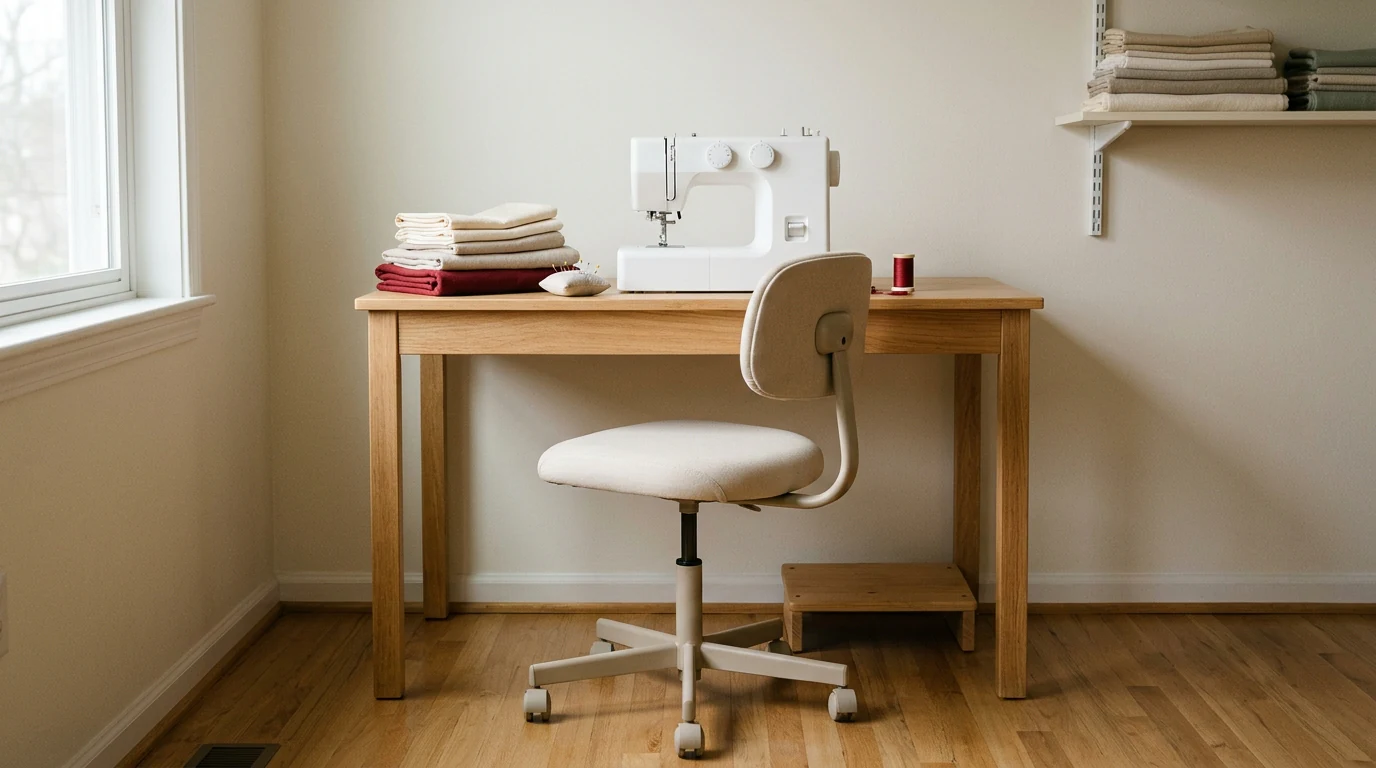
We chose the six picks on paper, by seat range, adjustments and weight rating. The steps below give you your own numbers to check any sewing chair.
Quick pick by setup
| Your setup | Chair type | Must-have | Pick |
|---|---|---|---|
| Desk-height table or cabinet | Armless task chair | Seat range that includes your number, lumbar support | Steelcase Series 1 |
| Long sessions or back pain | Fully adjustable chair | Lumbar height, seat depth, recline | Steelcase Series 1 or Horn SEW COZY |
| Tall sewist or high table | Dedicated sewing chair | Minimum height at or below your number | Arrow H7013B |
| Chair drifts off the pedal | Chair on glides | No casters, or locking casters | Supra Tailoring Chair |
| Counter-height table | Drafting chair | Tall lift plus a foot ring | Primy Drafting Chair |
| Knitting or crochet | Upright armless chair | Feet on the floor, back support | Any armless chair you own |
Step 1: Find your seat height
The Canadian Centre for Occupational Health and Safety (CCOHS) gives a rule of thumb: the optimal seat height is about one quarter of your body height. Torso and leg length vary, so treat it as your starting number, not your final answer.
| Body height | Starting seat height | Footrest, chair starting at 16½ in | Footrest, chair starting at 18 in |
|---|---|---|---|
| 4’10” (147 cm) | 14.5 in (37 cm) | 2 in (5 cm) | 3.5 in (9 cm) |
| 5’2” (157 cm) | 15.5 in (39 cm) | 1 in (3 cm) | 2.5 in (6 cm) |
| 5’6” (168 cm) | 16.5 in (42 cm) | None | 1.5 in (4 cm) |
| 5’10” (178 cm) | 17.5 in (44 cm) | None | 0.5 in (1 cm) |
| 6’2” (188 cm) | 18.5 in (47 cm) | None | None |
| 6’6” (198 cm) | 19.5 in (50 cm) | None | None |
Own calculation: body height ÷ 4, rounded to the nearest half inch and whole centimeter. Footrest = the chair’s lowest seat minus your starting number, if that is positive. 16½ in is the Steelcase Series 1 minimum, 18 in the Arrow H7013B minimum.
The ANSI/HFES 100-2007 standard recommends seat heights within 15–22 in (38–56 cm), but a chair only has to cover 4.5 in of that. Real sewing chairs start higher than many people’s number: 16 in for the Supra, 16¾ in for the Horn SEW COZY and 18 in for the Arrow. If the chair’s lowest setting is above your number, a footrest makes up the difference.

Now check it with your body. Sit with your feet flat on the floor. The sewing.org guideline on sewing room setup says your knees should be slightly lower than your hips. Shoes change the number, so measure in what you usually wear while sewing.
Step 2: Match the chair to your table
OSHA’s sewing-station guidance says chair height is right when the work surface is at elbow height, your whole foot rests on the floor, and the back of your knee is slightly higher than the seat.
The Canadian Quilters’ Association adds a detail many sewists miss: the average sewing machine is 3.5 in (about 9 cm) from its base to the sewing surface, so the needle sits that much above the tabletop. The association recommends that your hands rest on the sewing surface with elbows bent 90–110°.

When your seat height and the needle height don’t match, use this order:
- Lower the work if you can. A recessed cabinet or a lower table solves the problem at the source. Our guide to sewing machine tables and cabinets covers flush-mount options.
- Raise the seat if you can’t. Both the sewing.org setup guideline and the Canadian Quilters’ Association suggest raising the chair to fit a fixed table.
- Fill the gap under your feet. Once the seat goes up, add a footrest or a sturdy box so your feet rest flat again.
A worked example (own calculation): you are 5’6” (168 cm), so you start at 16.5 in (42 cm). Your table is fixed, and with your hands on the needle plate it sits about 2 in (5 cm) above your elbows. Raise the seat by 2 in to 18.5 in (47 cm), then add a 2 in (5 cm) footrest. If your starting number is your true feet-flat height, the footrest equals how far you raised the seat above it.
For close work that is hard to see, OSHA’s fine-work guidance allows a surface 2 to 4 inches above elbow height, with padded elbow rests. Good light helps too; see our guide to the best lamps for sewing.
What type of chair is best for sewing?

Armless task chair (best for most sewing machines)
An armless office-style task chair is the default: it adjusts and swivels toward the iron. Arms are the main problem: OSHA notes that armrests can stop a chair from getting close enough to the work, so you lean forward. The Canadian Quilters’ Association puts it plainly: no armrests are better than the wrong armrests.
Our pick: the Steelcase Series 1, with a 16½–21½ in (42–55 cm) seat and arms that drop to 23½ in (60 cm) from the floor. If it rolls off the pedal, the Supra Tailoring Chair sits on glides.
Dedicated sewing chair
Chairs sold as “sewing chairs” are usually armless with a pneumatic lift, a low back and often storage under the seat. The backs can be short: the Arrow’s backrest rises 10½ in above the seat. Judge them by the same fit points as any other chair. The Horn SEW COZY adds seat-depth and backrest adjustment; the Arrow H7013B starts at 18 in (46 cm), which suits tall sewists or a high table.
Drafting chair (for counter-height tables)
At a tall table, a regular chair can’t reach. A drafting chair has a long gas lift and a foot ring; set the ring so your feet rest flat, since dangling feet press on the underside of your thighs.
Our pick: the Primy Armless Tall Drafting Chair, 22–30 in (56–76 cm).
Saddle stools and kneeling chairs
Some sewists alternate a saddle stool or kneeling chair with a regular chair. Most of these seats have no backrest for breaks, so they work better as a second seat, like the JMU Saddle Stool.
Dining or kitchen chair
Fine for a short repair. As the Canadian Quilters’ Association points out, a dining chair is made for working at a table, not about 4 in (10 cm) above it. Add a firm cushion and a footrest.
Ergonomic sewing chair features for long hours
Features worth paying for, with numbers from the ANSI/HFES 100-2007 chair checklist (via Cornell University Ergonomics Web) and other guidance:
- Height range. The standard asks for at least 4.5 in (11.4 cm) of adjustment within 15–22 in (38–56 cm). Check that your own number falls inside the range the maker lists.
- Adjustable lumbar support. OSHA recommends a height-adjustable lumbar support whose outward curve fits the small of your back. CCOHS adds that it should also move forward and back.
- Seat depth. A fixed seat should be no deeper than 16.9 in (43 cm). The Canadian Quilters’ Association recommends a 2–3 finger gap between the seat edge and the back of your knee.
- Seat width. At least 17.7 in (45 cm) under the standard. Cornell suggests at least one inch of seat on each side of your hips and thighs.
- Waterfall edge. A rounded front edge, recommended by OSHA, eases pressure behind the knees.
- Recline for breaks. The standard requires a backrest that reclines at least 15° from vertical, so you can lean back between seams.
- Base and casters. CCOHS recommends a five-point base, hard casters for carpet and soft casters for hard floors. OSHA’s sewing guidance asks for no wheels or wheels that lock, so glides help if the chair rolls off the pedal.
- Foam that lasts. Cornell suggests checking comfort after 60–120 minutes; low-density foam deforms.
If you sew with back pain
A chair rarely fixes pain alone; hunching toward the needle undoes the best backrest. OSHA recommends frequent, short breaks to stretch or change position, and the Canadian Quilters’ Association suggests switching pedal feet now and then. If pain keeps coming back, talk to a doctor or physical therapist before buying an expensive chair.
Common sewing chair mistakes
- Buying features instead of fit. CCOHS notes that an “ergonomic” chair suits a range of people, with no guarantee it suits you.
- Sitting on the front edge. The sewing.org guideline says to sit all the way back.
- Raising the seat without a footrest. Dangling feet trade shoulder strain for thigh pressure.
Best chair for knitting and crocheting
Knitting and crochet usually happen away from a table. Modern Daily Knitting’s ergonomics column and Interweave’s crochet ergonomics guide both recommend sitting upright with your feet on the floor (Interweave also allows a low footrest), elbows close to your body and about 90° at hip and knee. Modern Daily Knitting adds that deep, reclined armchairs make you hold your arms up.
Both sources suggest resting the project on a pillow in your lap, so your arms don’t carry its weight. Modern Daily Knitting advises using armrests only to rest, not while you work, because pressure at the elbow can irritate the ulnar nerve. For project ideas, see our knit and crochet home decor ideas, and check yarn amounts with the Yarn Calculator.
How we research
We did not sit in or test chairs for this guide. The fit advice comes from OSHA, CCOHS, the ANSI/HFES 100-2007 chair requirements (via Cornell University Ergonomics Web), the sewing.org setup guideline (SEW-lutions 21.110, 2006), the Canadian Quilters’ Association, Modern Daily Knitting and Interweave. The tables and examples are our own calculations. Picks come from maker spec sheets and listings checked on 2026-11-03; where maker data conflict, the pick says so.
Bottom line
Measure first: about a quarter of your body height, needle plate at about elbow height. Then match the chair’s lowest setting to that number, pay for lumbar and seat-depth adjustment if you sew for hours, and close any gap with a footrest. To finish the room, see our sewing room ideas, craft room storage ideas, and the Quilt Planner for planning your next project.
Where our numbers come from
The linked sources are listed at the end of the page; all were accessed on 2026-11-03. What each one supports:
- OSHA, Sewing and Related Procedures eTool: Sewing Station Design. Chair at elbow height, feet flat, knee slightly higher than seat, no wheels or wheels that lock, frequent short breaks.
- OSHA, Sewing and Related Procedures eTool: Fine Work. Close work 2 to 4 inches above elbow height with padded elbow rests.
- OSHA, Computer Workstations eTool: Chairs. Height-adjustable lumbar support, recline at least 15 degrees, waterfall edge, armrests that block the chair.
- Cornell University Ergonomics Web, Chair Checklist (ANSI/HFES 100-2007). Seat height range at least 4.5 in (11.4 cm) within 15–22 in (38–56 cm); fixed seat depth no greater than 16.9 in (43 cm); seat width at least 17.7 in (45 cm); recline at least 15°.
- Cornell University Ergonomics Web, How to choose an ergonomic chair. Seat at least one inch wider than hips and thighs on each side; comfort check after 60–120 minutes.
- CCOHS, Office Ergonomics: Ergonomic Chair. Seat height about one quarter of body height (1/4); five-point base; hard casters for carpet, soft for hard floors.
- sewing.org SEW-lutions Guidelines, 21.110: Sewing Room Setup for Healthy Sewing (PDF dated January 2006, linked from the guidelines index as the site requests). Knees slightly lower than hips; sit all the way back; raise the chair to a fixed table and add a footrest.
- Canadian Quilters’ Association, The Best Seat in the House. Average machine 3.5 in (3½ in) from base to sewing surface; dining chairs are made for working at a table, “not 4″ above it”; elbows 90°–110°; 2–3 finger gap behind the knee.
- Modern Daily Knitting, Knitting Comfortably: A Chair Is a Tool. 90-degree hip and knee, backrest no higher than the shoulder blades, armrests only to rest, lap cushion.
- Interweave, Sit Up and Get a Grip: Ergonomics for Crocheters (updated 2024). Upright, feet on the floor or a low footrest, elbows close to the body, about 90-degree angles at elbow, hip and knee, project on a pillow in the lap or on a table.
- Steelcase, Series 1 product page. Chair supports users up to 400 lb; Limited Lifetime warranty, 12 years parts and labor; armless, height-adjustable or 4D arms; hard casters standard, soft casters or glides optional; stool version available.
- Steelcase, Series 1 product cut sheet (PDF). Seat height from floor: chair 16 1/2”–21 1/2” (16½–21½ in), stool 23”–30 ¾” (23–30¾ in); functional seat depth 15 3/4”–18” (15¾–18 in); seat width 19 1/2” (19½ in); back lumbar height 6 1/2”–8 3/4” (6½–8¾ in); arm to floor 23 1/2”–32 1/4” (23½–32¼ in); angle between seat and back 100°–124°; armless option.
- Horn of America, SEW COZY Standard Sewing Chair. Listed on 2026-11-03. Seat height 16.75”–21.25” (16¾–21¼ in), lowest seat position also listed as 16-1/4” (16¼ in); backrest height adjustment 6” range; seat depth adjustment 2-5/8” (2⅝ in); back angle 16° independent tilt; seat cushion 19” × 18”; 60 mm casters; version with adjustable arms.
- Arrow Sewing, Classic Sewing Furniture hydraulic chairs spec sheet (PDF, 2022, hosted by a retailer). H7013B: height adjustable from 18” to 22”; seat 18 × 16 in; backrest 10 1/2 in (10½ in) from the top of the seat; storage compartment 15 1/2 × 13 1/4 × 2 in (15½ × 13¼ × 2 in); weight capacity 300 lb; 1-year warranty.
- Amazon listing, Arrow H7013B. Seat height 18–22 in; maximum weight 150 kg; 1-year warranty; in stock on 2026-11-03.
- Amazon listing, Primy Armless Tall Drafting Chair. Seat height adjustable from 22 to 30 in; adjustable foot ring; armless; supports up to 250 lb; 1-year warranty; in stock on 2026-11-03.
- Amazon listing, JMU Saddle Stool. Height adjustment from 23 to 30 in; seat tilts downward 15°; up to 350 lb; 2.5-inch silent casters; in stock on 2026-11-03.
- Amazon listing, Steelcase Series 1 (Seagull frame, carpet casters). Fully adjustable arms, adjustable lumbar, adjustable seat depth; available on 2026-11-03, usually ships within 2 to 3 weeks.
- Supra Sewing, Adjustable Height Tailoring Chair (seller page). Seat height 16”–21”; seat 18” W × 18” D; height-adjustable backrest; five-star base with floor glides, casters not available; seller warranty; available on 2026-11-03.
Own calculations: seat height = body height ÷ 4 (source 6), rounded to 0.5 in and whole cm: 4’10” (58 in, 147 cm) → 14.5 in (37 cm); 5’2” (62 in, 157 cm) → 15.5 in (39 cm); 5’6” (66 in, 168 cm) → 16.5 in (42 cm); 5’10” (70 in, 178 cm) → 17.5 in (44 cm); 6’2” (74 in, 188 cm) → 18.5 in (47 cm); 6’6” (78 in, 198 cm) → 19.5 in (50 cm). Footrest example: 16.5 in + 2 in (5 cm) = 18.5 in (47 cm), footrest 2 in (5 cm). 3.5 in = 8.9 cm, rounded to 9 cm. Pick thresholds: 16.5 in × 4 = 66 in = 5’6”; 18 in × 4 = 72 in = 6’0” (183 cm). Footrest table: chair minimum minus starting number, e.g. 16.5 − 14.5 = 2 in (5 cm), 16.5 − 15.5 = 1 in (3 cm), 18 − 14.5 = 3.5 in (9 cm), 18 − 15.5 = 2.5 in (6 cm), 18 − 16.5 = 1.5 in (4 cm), 18 − 17.5 = 0.5 in (1 cm). 4 in = 10 cm; 16–21 in = 41–53 cm; 18 × 18 in = 46 × 46 cm. Metric conversions at 2.54 cm per inch and 0.4536 kg per lb, rounded: 16½–21½ in = 42–55 cm; 15¾–18 in = 40–46 cm; 19½ in = 50 cm; 6½–8¾ in = 17–22 cm; 23½–32¼ in = 60–82 cm; 23–30¾ in = 58–78 cm; 16¾–21¼ in = 43–54 cm; 6 in = 15 cm; 2⅝ in = 7 cm; 19 × 18 in = 48 × 46 cm; 18–22 in = 46–56 cm; 18 × 16 in = 46 × 41 cm; 10½ in = 27 cm; 22–30 in = 56–76 cm; 23–30 in = 58–76 cm; 400 lb = 181 kg; 300 lb = 136 kg; 250 lb = 113 kg; 350 lb = 159 kg; 150 kg = 330 lb. Step numbers 1–3 in lists are ordinals, not data.
Fit check before you keep a chair
Questions people ask
What type of chair is best for sewing?
For most sewists, an armless, height-adjustable task chair with lumbar support and a rounded waterfall front edge. Its seat range has to include your seat height, roughly a quarter of your body height. If you sew at a counter-height table, a drafting chair with an adjustable foot ring is the better type.
What height should a sewing chair be?
Start at about a quarter of your body height, then fine-tune: feet flat, knees a little lower than hips, and your hands resting on the needle plate with elbows bent 90–110°. A 5'6" (168 cm) sewist starts near 16.5 in (42 cm). If the table forces you higher, raise the seat and add a footrest.
Is an office chair good for sewing?
Often yes, if it is armless or its arms move out of the way, its seat range includes your number, and it has adjustable lumbar support. The ANSI/HFES 100-2007 standard expects at least 4.5 in (11.4 cm) of height adjustment within 15–22 in (38–56 cm).
Should a sewing chair have wheels?
Wheels help you move between machine, cutting table and iron, but they can drift when you press the pedal. OSHA's sewing-station guidance calls for no wheels or wheels that lock. Match casters to your floor: hard for carpet, soft for hard floors.
What is the best sewing chair for back pain?
One you can adjust: lumbar support that moves up and down, seat depth so the edge clears your knees, and a backrest that reclines at least 15° for breaks. Posture and short breaks matter as much as the chair; see a health professional if pain keeps coming back.
What is the best chair for knitting and crocheting?
An upright chair that lets your feet rest on the floor, supports your lower back and keeps your elbows at your sides. A pillow on your lap carries the work, so your shoulders can relax.
Sources and changes
- OSHA, Sewing and Related Procedures eTool: Sewing Station Design
- OSHA, Sewing and Related Procedures eTool: Fine Work
- OSHA, Computer Workstations eTool: Chairs
- Cornell University Ergonomics Web, Chair Checklist (ANSI/HFES 100-2007), PDF
- Cornell University Ergonomics Web, How to choose an ergonomic chair
- CCOHS, Office Ergonomics: Ergonomic Chair
- sewing.org SEW-lutions Guidelines, 21.110: Sewing Room Setup for Healthy Sewing
- Canadian Quilters' Association, The Best Seat in the House
- Modern Daily Knitting, Knitting Comfortably: A Chair Is a Tool
- Interweave, Sit Up and Get a Grip: Ergonomics for Crocheters
- Steelcase, Series 1 product page
- Steelcase, Series 1 product cut sheet (PDF)
- Horn of America, SEW COZY Standard Sewing Chair
- Arrow Sewing, Classic Sewing Furniture hydraulic chairs spec sheet (PDF, retailer-hosted)
- Amazon listing, Arrow H7013B
- Amazon listing, Primy Armless Tall Drafting Chair
- Amazon listing, JMU Saddle Stool
- Amazon listing, Steelcase Series 1
- Supra Sewing, Adjustable Height Tailoring Chair (seller page)
What changed
- Draft written; switched to a buying guide with six picks; seat-height table now shows footrest needs.