
Craft room · Guide
Sewing Room Ideas: Layout, Small Spaces & Setup Checklist
Plan the room in four zones, set four numbers right, and pick furniture, light and storage from our craft room guides.
The short answer
Good sewing room ideas start with layout, not decor. Split the room into four zones: sew, press, cut and store. Then set four things right: the needle at seated elbow height, a chair seat around a quarter of your body height, 2,000 to 5,000 lux of task light at the needle, and a closed, dry place for fabric. In a small room, stack storage up the inside walls and fold the table away.
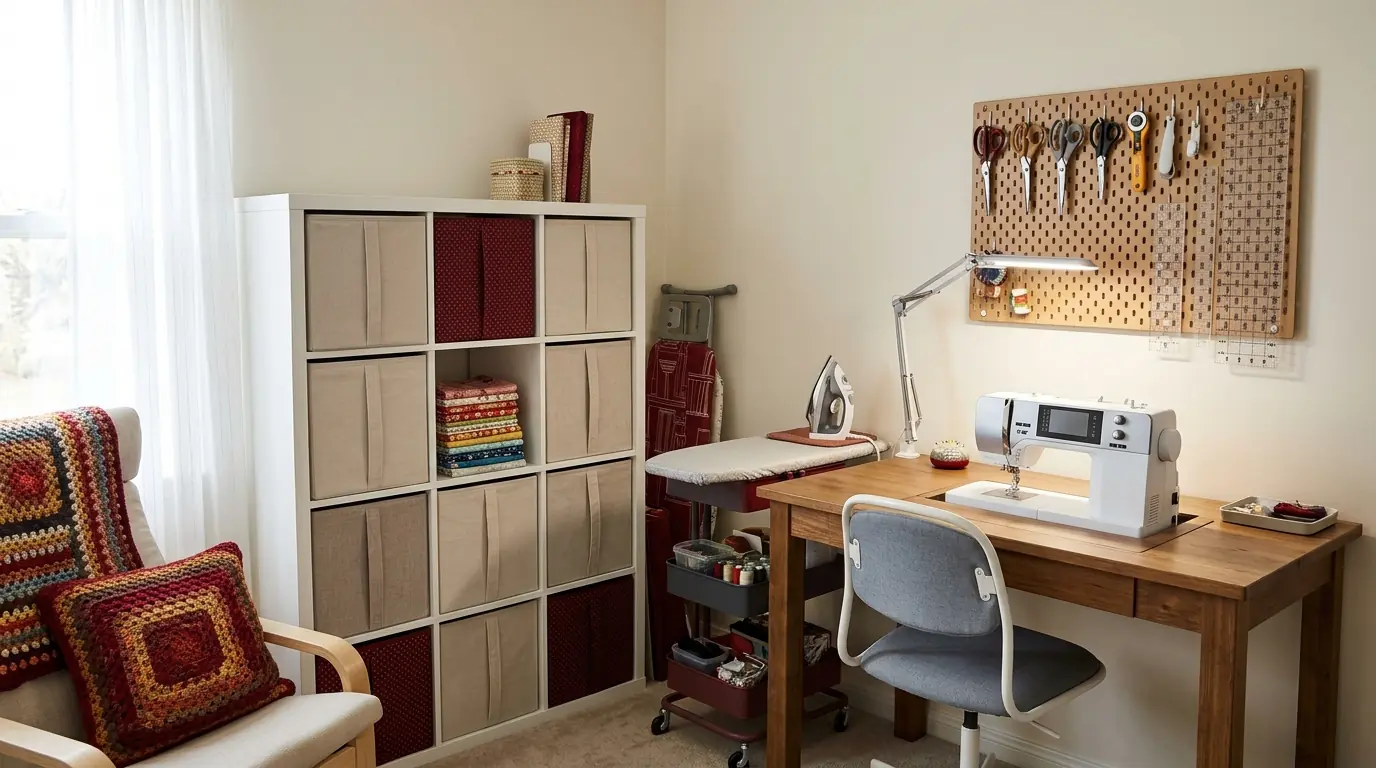
Most sewing room ideas online are pictures of finished rooms. They look great, but they rarely tell you why a room works. This guide is the plan behind the pictures: where each zone goes, the four numbers that decide whether you can sew for hours without a sore neck, and which of our guides covers each piece of furniture. It works for a spare bedroom, a corner of the living room or a closet.
Sewing room ideas at a glance
Each part of the room has its own guide. Start with the one that bothers you most today.
| If you need… | Read | The one thing to know |
|---|---|---|
| A table or cabinet | Best sewing machine tables | Match the needle to your seated elbow height |
| A chair | Best sewing chairs | Armless, with a seat range around a quarter of your body height |
| Better light | Best lamps for sewing | 2,000 to 5,000 lux at the needle, from the side |
| Storage | Craft room storage ideas | 20 ideas that keep fabric, yarn and thread dark, dry and clean |
| Decor you make | Crochet home decor patterns | 16 free patterns for lampshades, pillows and poufs |
| A fun rug | Crochet egg rug pattern | A fried egg rug in four sizes |
Plan the layout: four zones

A sewing room has four jobs, and each needs its own spot.
- Sew. The table, the chair and a task lamp. Put the table along a wall with the window to the side, not behind the machine and not in your face. The lamp goes on the side opposite your writing hand, which is the left for most people.
- Press. You press after almost every seam, so the iron belongs one turn of the chair away. A small ironing board at table height beside or behind the chair saves hundreds of trips.
- Cut. Cutting is done standing. A table you can walk around on three sides lets you reach across a long piece of fabric without dragging it.
- Store. Fabric, yarn and thread fade in light and mould in damp air. Closed cabinets go on an inside wall, out of the sun, and not against a cold outside wall where condensation can form.
This layout is our suggestion, not a standard. Draw your room to scale first, with the door swing and the outlets, then place the zones. The dashed line in the plan is the short path from the sewing chair to the iron that makes the arrangement work.
Four numbers that set up a sewing room

1. Needle height. OSHA’s guidance for sewing stations puts the work surface at elbow height, and up to 4 in above it for close, hard-to-see work. A machine sitting on top of a table raises the needle about 3.5 in above the tabletop, according to the sewing.org guidelines. That is why a cabinet with a lift, which drops the machine flush with the top, suits many sewists better. Our sewing table guide has a height chart by body size.
2. Chair seat. The Canadian Centre for Occupational Health and Safety (CCOHS) suggests a starting seat height of about a quarter of your body height. Pick an armless chair whose range includes that number, then fine-tune until your elbows meet the needle. The sewing chair guide explains how to read a chair’s seat range.
3. Light at the needle. CCOHS lists general lighting at 500 to 1,000 lux, but small, low-contrast tasks such as sewing at 2,000 to 5,000 lux. A ceiling light alone rarely gets there. Clamp a task lamp to the table and angle the shade away from your eyes. The sewing lamp guide compares seven lamps against those numbers.
4. Humidity in the stash. The Canadian Conservation Institute notes that mould can grow at 70% relative humidity in about 3 months. Keep a hygrometer in the cabinet and check it each season. The storage guide covers light, pests and folds as well.
Sewing room layout ideas by room shape
Spare bedroom. The classic plan above fits: sewing table on the wall beside the window, cutting table in the middle, storage on the inside wall. If the bed stays, the cutting table can be a board that rests on the bed frame, and the stash goes in lidded boxes underneath, where it is dark.
L-shaped corner. Put the machine on one leg of the L and the ironing spot or a second machine on the other. You swivel instead of standing up, which keeps the press zone one turn of the chair away. Check that the lamp still reaches the needle from the side opposite your writing hand.
Long, narrow room. Line up the zones along one wall in working order: cut, sew, press. Keep the opposite wall for shallow, closed shelves, so the walkway stays clear.
Corner of a shared room. A cabinet that closes over the machine, a rolling cart and a folding screen turn the sewing corner back into living space in a minute. Lidded boxes keep fabric away from sunlight from the room’s windows.
Small sewing room ideas
A small room needs the same four zones; they just overlap.
- Fold the table away. A folding sewing table with an insert puts the machine flush and packs flat when you are done. Our table guide includes one.
- Use the walls. A pegboard above the table keeps scissors and rulers in reach. Tall, closed shelves on an inside wall take the stash.
- Roll the current project. A rolling cart holds the project you are working on and parks in a corner.
- Convert a closet. A reach-in closet takes a narrow table, a shelf and bins. Close the doors and it is dark and dust-free.
- Press on the table. A tabletop pressing mat replaces the full ironing board in a pinch.
- Sit on your storage. A bench with storage holds notions and fat quarters. Check the inside depth before you plan bigger items around it.
Sewing room organization ideas
Organize by how often you reach for something. Daily tools go within arm’s reach of the chair. This season’s project sits in an open bin or on the cart. The long-term stash goes behind doors or in lidded, opaque boxes. Thread racks look tidy on a wall, but thread fades like fabric, so hang them inside a cabinet door or on a wall that never sees direct sun. The craft room storage ideas guide has 20 ideas with a rule for each.
Make it a room you want to sit in
Comfort is part of the setup. A crocheted cushion on a reading chair, a covered lampshade on an LED bulb or a pouf to rest your feet on make the room yours. Quilters can size the next project with the Quilt Planner. Our crochet home decor guide links 16 free patterns, with sizing and lamp safety. If you like a laugh, the fried egg rug is a beginner circle.
How we research
We did not build a test room. The layout is our own suggestion; the numbers come from OSHA, CCOHS, the University of California, the sewing.org guidelines and the Canadian Conservation Institute, the same sources behind our individual craft room guides.
Sewing room setup checklist
Questions people ask
How do you set up a small sewing room?
Put the machine against a wall with the light coming from the side, store upward on an inside wall, and use furniture that folds or rolls: a folding sewing table, a rolling cart for the current project and a storage bench. A reach-in closet can become a sewing nook with a narrow table and a shelf.
What is the best layout for a sewing room?
Four zones in a loose triangle: the sewing table, an ironing spot one turn of the chair away, a stand-up cutting table, and closed storage on an inside wall. That is our suggestion; adapt it to your windows, door and outlets.
How bright should a sewing room be?
General room light is usually 500 to 1,000 lux, says the Canadian Centre for Occupational Health and Safety; small, low-contrast tasks such as sewing need 2,000 to 5,000 lux. A clamp-on task lamp at the needle covers the gap.
How high should a sewing table be?
The needle plate should sit at your seated elbow height, or up to 4 in above it for close work, per OSHA. A machine sitting on top of a table puts the needle about 3.5 in above the tabletop, so a cabinet with a lift often fits better.
Sources and changes
- OSHA, Sewing and Related Procedures eTool: Fine Work. Work surface at elbow height, 2 to 4 inches higher for close work; adjustable task lighting and magnifiers at fine-work stations. (retrieved 2026-11-03)
- CCOHS, Office Ergonomics: Ergonomic Chair. Starting seat height about a quarter of body height; adjustable seat and back. (retrieved 2026-11-03)
- CCOHS, Lighting Ergonomics: Survey and Solutions. General lighting usually 500 to 1,000 lux; 2,000 to 5,000 lux for low-contrast, very small tasks over a long period, including sewing. (retrieved 2026-11-03)
- University of California Office of the President, Task Lighting (PDF). Lamp on the side opposite the writing hand, shade angled away from the eyes. (retrieved 2026-11-03)
- sewing.org SEW-lutions Guidelines, 2.101 Setting Up a Sewing Room and 21.110 Sewing Room Setup for Healthy Sewing. Needle about 3.5 in above the table for a machine on top. (retrieved 2026-11-03)
- Canadian Conservation Institute (CCI) Note 13/1: Textiles and the Environment. Light damage is cumulative; mould at 70% RH in 3 months or more; avoid cabinets on cold exterior walls and basements. (retrieved 2026-11-03)
- CDC STEADI: Check for Safety, A Home Fall Prevention Checklist for Older Adults. Remove throw rugs, or use double-sided tape or a non-slip backing. (retrieved 2026-11-03)
What changed
- Draft written.