
Craft room · Buying guide
Best Sewing Machine Tables: Match the Needle to You
Six tables and cabinets compared on paper by the number that matters most: where they put your needle relative to your elbows.
The short answer
For most sewists, a cabinet with a lift that sets the machine bed flush with the top, so the needle sits at tabletop height instead of 3.5 in above it. Check the lift opening and weight limit against your machine, and the tabletop height against your elbow height.
Our picks at a glance
Best overall
Most sewists with a mid-size machine and limited floor space who want a real flatbed lift.
Best full-size cabinet
Kangaroo Wallaby II Sewing Cabinet
Quilters and garment sewists who want a big flat surface around the needle plus a place for a serger.
Best electric lift
Horn Model 4200 Electric Lift Sewing Cabinet
Heavy machines and sewists who want to change lift positions at the push of a button.
Best sit-stand table
Sewists who also serge, cut or press standing, and want one table for all of it.
Best budget
Sauder Sewing Craft Cart (426934)
Occasional sewing and craft storage on a small budget, if you can live with a top-mount machine.
See it at Amazon (opens in a new tab)Best portable
Classes, retreats and small rooms where the table has to fold away.
Which one is for you
| If you… | Buy… |
|---|---|
| want a flatbed cabinet that fits a small room | Arrow Judy |
| quilt or serge and have the floor space | Kangaroo Wallaby II |
| have a heavy or wide machine | Horn Model 4200 |
| also cut or serge standing | Arrow Eleanor II |
| need storage on a small budget | Sauder Sewing Craft Cart |
| sew at classes or need to fold the table away | SewEzi Portable |
01Best overall
Arrow Judy Sewing Cabinet
Best for: Most sewists with a mid-size machine and limited floor space who want a real flatbed lift.
A compact cabinet with a three-position hydraulic lift. Closed it is 25½ in (65 cm) wide; open, the machine bed sits flush with a 29½ in (75 cm) top.
- Sewing surface height
- 29½ in (75 cm) open; 30⅛ in (77 cm) closed
- Top size
- Open 50¾ × 17¼ in (129 × 44 cm); closed 25½ × 17¼ in (65 × 44 cm)
- Lift
- Hydraulic, 3 positions: free arm, flatbed, storage
- Lift opening
- A10, 20¾ × 11 × 13½ in (53 × 28 × 34 cm)
- Machine weight limit
- 55 lb (25 kg)
- Casters
- Heavy-duty locking casters
- Warranty
- 10 years
Why we like it
- Flatbed position puts the needle at tabletop height, 3.5 in (9 cm) lower than a machine standing on the same top.
- Small closed footprint, on casters.
- Leaves cover the machine well when the machine is stored.
Keep in mind
- The 17¼ in (44 cm) depth leaves little room behind the needle for quilts.
- The maker states it cannot take returns, and it ships flat for home assembly.
Skip it if your machine is wider than 20¾ in or deeper than 11 in at the base.
How we know: Maker product page and product sheet, linked in Sources. Owner reviews on the maker page mention a long assembly. We did not assemble this cabinet.
02Best full-size cabinet
Kangaroo Wallaby II Sewing Cabinet
Best for: Quilters and garment sewists who want a big flat surface around the needle plus a place for a serger.
A large cabinet that opens to 70⅝ × 59⅞ in (179 × 152 cm), with a hydraulic lift, a fold-out serger leaf and a quilt leaf at the back.
- Sewing surface height
- 29½ in (75 cm) open; 30¼ in (77 cm) closed
- Top size
- Open 70⅝ × 59⅞ in (179 × 152 cm); closed 42¾ × 19 in (109 × 48 cm)
- Lift
- Hydraulic, 3 positions: free arm, flatbed, storage
- Lift opening
- Not stated; a machine-specific insert is offered
- Machine weight limit
- 55 lb (25 kg)
- Casters
- Locking industrial casters
- Warranty
- Lifetime
Why we like it
- Ships fully assembled.
- Quilt leaf keeps large projects from pulling off the back.
- Lifetime warranty.
Keep in mind
- Needs a lot of floor space when open.
- Assembled delivery is a required paid add-on, and the dealer page gives both 2–3 and 5–6 weeks for delivery.
Skip it if you sew in a corner of a bedroom or living room.
How we know: Authorized dealer product page (dimensions, lift, warranty, delivery terms), linked in Sources. We did not assemble this cabinet.
03Best electric lift
Horn Model 4200 Electric Lift Sewing Cabinet
Best for: Heavy machines and sewists who want to change lift positions at the push of a button.
A made-in-USA cabinet with an electric lift for free arm, flatbed and storage, a 25 × 13 in (64 × 33 cm) cut-out and a drop leaf.
- Sewing surface height
- 29¾ in (76 cm)
- Top size
- Open 41¾ × 39¼ in (106 × 100 cm); closed 41¾ × 20½ in (106 × 52 cm)
- Lift
- Electric, 3 positions: free arm, flatbed, storage
- Lift opening
- 25 × 13 in (64 × 33 cm)
- Machine weight limit
- 80 lb (36 kg) for Horn electric lifts, per the dealer page
- Casters
- Lockable casters; cabinet weighs 175 lb (79 kg)
- Warranty
- Limited lifetime
Why we like it
- Largest stated opening and highest weight limit here.
- Electric lift, so no lever to push down.
Keep in mind
- At 29¾ in (76 cm) the top is the highest of the fixed cabinets here.
- Heavy, and the dealer quotes 3–4 weeks for delivery.
Skip it if your machine weighs under 30 lb and fits a smaller opening; the Judy does the same job for less.
How we know: Maker product page and an authorized dealer page, linked in Sources. We did not use this cabinet.
04Best sit-stand table
Arrow Eleanor II Sewing Table
Best for: Sewists who also serge, cut or press standing, and want one table for all of it.
An electric height-adjustable table from 28.7 to 48.4 in (73 to 123 cm) with four memory settings and a manual lift for free arm and flatbed.
- Sewing surface height
- 28.7–48.4 in (73–123 cm), electric, 4 memory settings
- Top size
- Not stated on the product page; left extension panel removable
- Lift
- Manual, free arm and flatbed
- Lift opening
- Fits standard sergers and sewing machines, per the maker
- Machine weight limit
- 40 lb (18 kg)
- Casters
- Optional, sold separately (out of stock on Nov 3, 2026)
- Warranty
- 5 years frame and motor; 2 years electronics
Why we like it
- Goes from sitting to standing height, so it doubles as a cutting table.
- Memory settings save your sewing and serging heights.
Keep in mind
- Its lowest setting is still 28.7 in (73 cm), so it does not go lower than a cabinet.
- Lowest machine weight limit here.
Skip it if you only sew seated; a fixed cabinet costs less.
How we know: Maker product page, linked in Sources. We did not use this table.
05Best budget
Sauder Sewing Craft Cart (426934)
Best for: Occasional sewing and craft storage on a small budget, if you can live with a top-mount machine.
A drop-leaf cart on casters with bins and a hidden shelf for the machine. There is no lift: the machine sits on a 28½ in (72 cm) top.
- Sewing surface height
- Tabletop 28½ in (72 cm); the machine sits on top
- Top size
- 40 × 19½ in (102 × 50 cm) listed; drop leaf adds space
- Lift
- None; hidden shelf stores the machine
- Lift opening
- None
- Machine weight limit
- 75 lb (34 kg) listed maximum
- Casters
- Easy-roll casters
- Warranty
- 5-year limited
Why we like it
- The budget pick: far cheaper than any lift cabinet here.
- Storage for thread, notions and the machine in one piece.
Keep in mind
- Top-mount puts the needle about 3.5 in (9 cm) above the top, about 32 in (81 cm) from the floor.
- No flatbed surface around the needle.
Skip it if you sew for hours or quilt; the needle sits high for most people.
How we know: Maker data on the Amazon listing, linked. We did not assemble this cart.
06Best portable
SewEzi Portable Sewing Table
Best for: Classes, retreats and small rooms where the table has to fold away.
A folding table with a custom acrylic insert, so the machine sits down in the table at a flatbed height of 29 in (74 cm).
- Sewing surface height
- 29 in (74 cm)
- Top size
- 34 × 19 in (87 × 48 cm)
- Lift
- None; machine hangs in the table, insert height adjusts with spacers
- Lift opening
- Insert cut for your machine model; larger machines need the Grande table
- Machine weight limit
- Not stated
- Casters
- None; folding legs, table weighs 22 lb (10 kg)
- Warranty
- Not stated on the product page
Why we like it
- Flatbed sewing that folds for a closet or under a bed.
- Lightest pick, at 22 lb (10 kg).
Keep in mind
- The usual limit is the width of the machine at the back right; check the fit with the maker.
- No storage.
Skip it if you have a large, heavy machine.
How we know: Maker product page with specifications and fit notes, linked in Sources. We did not use this table.
A sewing machine table works when it puts the needle where your hands want to be: at about elbow height while you sit. The best sewing table for most people is a cabinet with a lift that drops the machine until its bed is flush with the top, so you sew on a flat surface instead of reaching up 3.5 in (9 cm) to the needle plate. Then check three numbers against your machine: the lift opening, the weight limit and the top height.
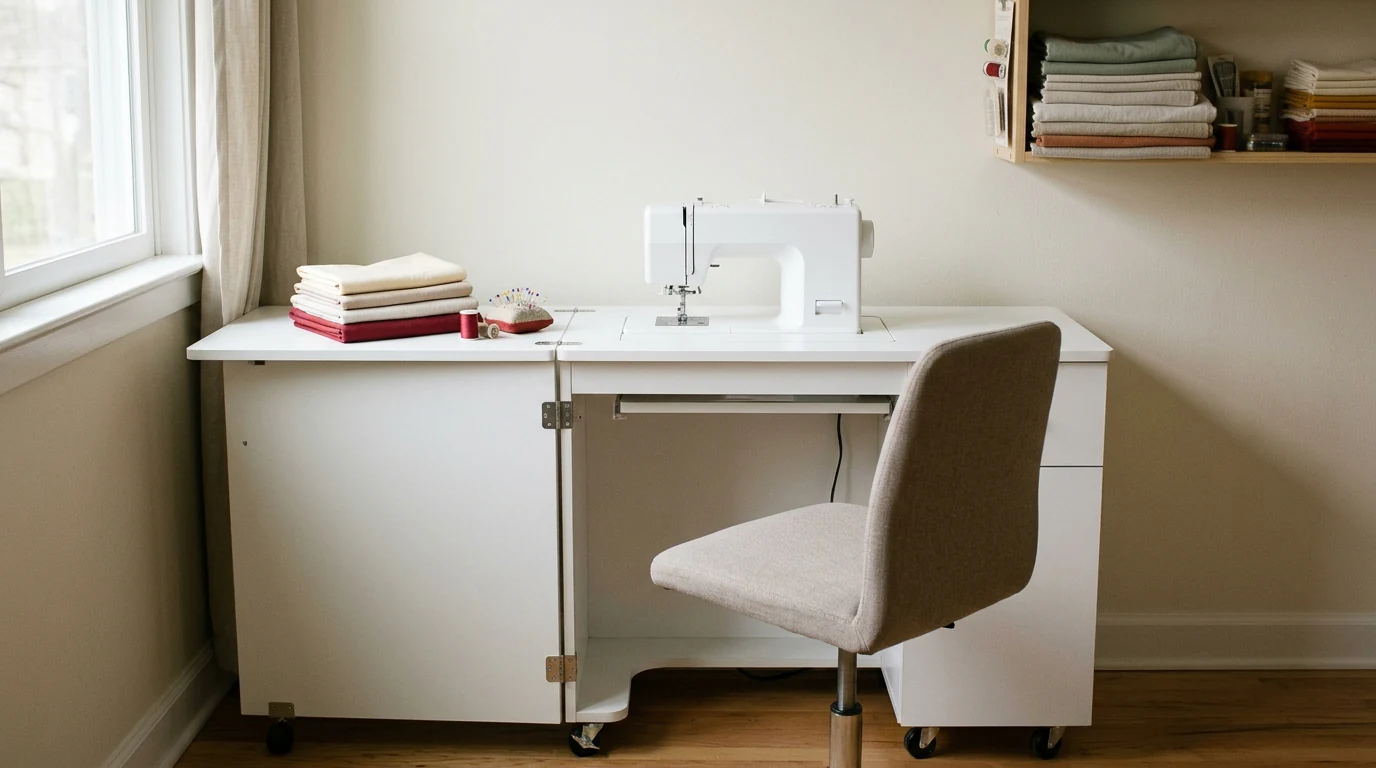
We compared six tables and cabinets on paper, from maker and dealer spec pages. The steps below give you your own numbers first.
Quick pick by setup
| Your setup | Table type | Must-have | Pick |
|---|---|---|---|
| Small room, regular sewing | Compact lift cabinet | Flatbed lift, casters | Arrow Judy |
| Quilting or a serger too | Full-size cabinet | Large leaves, lift | Kangaroo Wallaby II |
| Heavy or wide machine | Electric lift cabinet | Big opening, high weight limit | Horn Model 4200 |
| Sewing, serging and cutting | Sit-stand table | Electric height range | Arrow Eleanor II |
| Tight budget | Craft cart | Storage, casters | Sauder Sewing Craft Cart |
| Classes or a fold-away corner | Folding flatbed table | Light, folds flat | SewEzi Portable |
Step 1: Find your needle height
OSHA’s sewing-station guidance says the work surface belongs at elbow height, and its fine-work guidance allows 2 to 4 inches higher for close work that is hard to see. The sewing.org guideline on setting up a sewing room puts it the same way: the ideal machine bed height is the distance from your elbow to the floor.
Your elbow height depends on your seat height, so we started from the CCOHS rule of thumb used in our sewing chair guide: a starting seat of about a quarter of your body height. Then we added seated elbow height from US body-size data (NC State Ergonomics Center, from the ANSUR II survey).
| Body size | Starting seat | Elbow height, seated | Needle target | 29½ in flatbed cabinet vs. elbow | Top-mount on a 28½ in table vs. elbow | Raise seat + footrest for the cabinet |
|---|---|---|---|---|---|---|
| 5th percentile woman, 5’0” (153 cm) | 15 in (38 cm) | 22.5 in (57 cm) | 22.5–26.5 in (57–67 cm) | +7 in (18 cm) | +9.5 in (24 cm) | 3–7 in (8–18 cm) |
| Median woman, 5’4” (163 cm) | 16 in (41 cm) | 25 in (64 cm) | 25–29 in (64–74 cm) | +4.5 in (11 cm) | +7 in (18 cm) | 0.5–4.5 in (1–11 cm) |
| Median man, 5’9” (175 cm) | 17.5 in (44 cm) | 27 in (69 cm) | 27–31 in (69–79 cm) | +2.5 in (6 cm) | +5 in (13 cm) | 0–2.5 in (0–6 cm) |
| 95th percentile man, 6’2” (187 cm) | 18.5 in (47 cm) | 30 in (76 cm) | 30–34 in (76–86 cm) | −0.5 in (1 cm) | +2 in (5 cm) | None |
Own calculation: seat = body height ÷ 4; elbow height = seat + seated elbow height; needle target = elbow height to 4 in above it. A top-mount needle sits 3.5 in above a 28½ in table, at 32 in. The last column runs from the raise that reaches the top of your target to the raise that reaches elbow height. Rounded to 0.5 in and whole centimeters.

The pattern is clear: almost every table here puts the sewing surface at 28.7–29¾ in (73–76 cm), set for a tall sewist. Penn EHRS says the same about office desks: at 29–30 inches, they put the hands too high for a large number of people. OSHA’s purchasing guide asks for keyboard heights of 22 to 30 inches for seated work, a range that covers all four of our elbow heights.
Body proportions vary, so measure yourself: sit at your usual seat height, let your upper arms hang and bend your elbows to 90°, then measure from the underside of the forearm to the floor.
The sewing.org guideline for healthy sewing (21.110) measures differently. It has you hold a magazine as if reading, then add 5.5–7 in (14–18 cm) to your elbow height, and it calls most cabinets too low. That method suits a machine tilted toward you; if you sew with your elbows at your sides, start from OSHA’s range.
When the table is too high
You can’t cut down a lift cabinet, so raise the chair and support your feet. Both the sewing.org guideline and the Canadian Quilters’ Association recommend raising the chair to fit a fixed table. The footrest equals the height you added: a median-height woman at a 29.5 in (75 cm) cabinet raises her seat 0.5–4.5 in (1–11 cm) and adds the same under her feet. Our guide to sewing chairs shows which chairs reach those heights.
Step 2: Choose how the machine sits

The sewing.org guideline points out the difference between sewing surface and table height. Set into a table or cabinet, the two are the same. On top of a table, the needle sits higher than the table: about 3.5 in (9 cm) for the average machine, according to the Canadian Quilters’ Association.
- Top-mount. The machine stands on the tabletop, like on the Sauder cart. Cheapest, but on a 28½ in (72 cm) top the needle lands near 32 in (81 cm), above the target range for everyone in our table except the tallest.
- Flatbed (drop-in). A lift or a hanger lowers the machine until its bed is flush with the top. An acrylic insert cut for your model fills the gap, so fabric glides flat. This is how the Arrow Judy, Wallaby II and SewEzi work.
- Free arm. The lift rises until its platform is flush with the top, and the machine sits on it. You lose the flatbed but can slide sleeves and cuffs around the free arm.
- Storage. The lift drops the machine inside so the closed cabinet becomes a work surface.
Hydraulic lifts are moved by hand; the Horn Model 4200 uses an electric lift with a button. The Eleanor II raises the whole table instead, from 28.7 to 48.4 in (73 to 123 cm), so it can go up to standing height but not below a regular cabinet.
Sewing tables for small spaces
- Measure it open. The Judy is 25½ × 17¼ in (65 × 44 cm) closed and 50¾ in (129 cm) wide open. The Wallaby II grows from 42¾ × 19 in (109 × 48 cm) to 70⅝ × 59⅞ in (179 × 152 cm).
- Add chair room. Leave space to pull the chair in and turn toward the iron.
- Fold or roll it away. Casters let a cabinet live against a wall; the SewEzi folds for a closet.
- Store upward. Wall shelves and pegboards keep the top clear; see our craft room storage ideas.
What to check before you buy
- Opening and insert. Measure the machine’s base, including knobs. Openings differ by cabinet, from 20¾ × 11 in (53 × 28 cm) on the Judy to 25 × 13 in (64 × 33 cm) on the Horn 4200.
- Weight limit. Lift limits here run from 40 lb (18 kg) on the Eleanor II to 80 lb (36 kg) for Horn electric lifts.
- Depth. A shallow top like the Judy’s 17¼ in (44 cm) leaves little room behind the needle. Quilters want more.
- Stability. OSHA’s sewing-station guidance favors tables you can adjust in height. Lock the casters before you sew.
- Assembly and returns. Some cabinets ship flat with many parts, and the Judy cannot be returned.
How we research
We did not assemble or sew at any table for this guide. Height advice comes from OSHA, Penn EHRS, the sewing.org guidelines, the Canadian Quilters’ Association and NC State body-size data. The height table and examples are our own calculations. Picks come from maker and authorized-dealer pages checked on 2026-11-03; where the data are incomplete or conflict, the pick says so.
Bottom line
Measure your seated elbow height first. If a cabinet’s flatbed sits within 4 in (10 cm) above it, you are set; if it sits higher, raise your seat and add a footrest. Then match the lift opening and weight limit to your machine. For the rest of the room, see our sewing room ideas and lighting for sewing. Planning a quilt for your new table? The Quilt Planner works out the shopping list, with separate tools for backing, binding and standard quilt sizes.
Where our numbers come from
The linked sources are listed at the end of the page; all were accessed on 2026-11-03. What each one supports:
- OSHA, Sewing and Related Procedures eTool: Sewing Station Design. Work surface at elbow height; height- and tilt-adjustable tables.
- OSHA, Sewing and Related Procedures eTool: Fine Work. Close work 2 to 4 inches above elbow height.
- OSHA, Computer Workstations eTool: Purchasing Guide Checklist. Keyboard height adjustable between 22 inches and 30 inches for seated tasks, at about elbow height.
- Penn EHRS, Selecting Office Furniture. A typical office desk is 29-30 inches high, too high for a large number of office workers.
- NC State Ergonomics Center, Anthropometric Data for U.S. Adults. Stature: women 5th percentile 60.04 in, median 64.02 in; men median 69.09 in, 95th percentile 73.62 in. Sitting elbow height: women 5th 7.44 in, median 9.17 in; men median 9.69 in, 95th 11.46 in.
- CCOHS, Office Ergonomics: Ergonomic Chair. Seat height about one quarter (1/4) of body height.
- sewing.org SEW-lutions Guidelines 2.101 (2011) and 21.110 (2006). 2.101: ideal machine bed height is the distance from your elbow to the floor. 21.110: set-in machine means sewing surface and table height are the same; machine on top means the table is lower than the sewing surface; measure elbow to floor while reading and add 5.5” to 7”; cabinets usually tend to be too low; raise the chair and add a footrest at a fixed table.
- Canadian Quilters’ Association, The Best Seat in the House. Average sewing machine 3½” (3.5 in) from bottom to sewing surface; adjust the chair when the table can’t be adjusted.
- sewingcabinets.com, Machine lift positions. Free-arm position with the lift surface flush with the cabinet; flat-bed position with a flat, seamless work surface; storage position.
- Arrow Sewing, Judy Sewing Cabinet. In stock on Nov 3, 2026 (Add to Bag); open 50-3/4” W × 17-1/4” D × 29-1/2” H; closed 25-1/2” W × 17-1/4” D × 30-1/8” H; lift opening A10, 20-3/4” W × 11” D × 13-1/2” H; hydraulic 3-position lift; 55 lb limit; locking casters; 10-year warranty; no returns.
- Kangaroo Wallaby II Cabinet at sewingcabinets.com. In stock on Nov 3, 2026; ships assembled with a required paid Premium Delivery add-on; closed 42 ¾” W × 19” D × 30 ¼” H; open 70 ⅝” W × 59 ⅞” D × 29 ½” H; three-position hydraulic lift; up to 55 lbs; locking industrial casters; lifetime warranty; delivery notes of 2-3 weeks and 5-6 weeks.
- Horn of America, Model 4200. Listed on Nov 3, 2026; 25” × 13” cut-out; open 41-3/4” W × 39-1/4” D × 29-3/4” H; closed 41-3/4” W × 20-1/2” D × 29-3/4” H; 175 lbs; electric lift; limited lifetime warranty.
- Horn Model 4200 at sewingcabinets.com. In stock on Nov 3, 2026, 3-4 weeks delivery; electric lift for free arm, flatbed and storage up to 80 lbs; lockable casters.
- Arrow Sewing, Eleanor II. Add to Bag on Nov 3, 2026; height 28.7” - 48.4”; 4 memory settings; manual lift for free arm and flat bed; up to 40 lbs; 5-year warranty frame and motor, 2-year electronics; optional casters, out of stock on Nov 3, 2026.
- Amazon listing, Sauder Sewing Craft Cart 426934. In Stock on Nov 3, 2026; L 40.08” × W 19.49” × H 28.54”; drop leaf; casters; hidden shelf for the machine; weight capacity maximum 75 pounds; 5-year limited warranty.
- SewEzi USA, Portable Sewing Table. Available on Nov 3, 2026; top 87 × 48 cm (34” × 19”); height 74 cm (29”); weight 10 kg (22 lbs); acrylic insert and carry case included; spacers adjust insert height; larger machines need the Grande table.
Own calculations: seat = stature ÷ 4 (source 6), elbow height = seat + sitting elbow height (source 5), rounded to 0.5 in: 60.04 ÷ 4 + 7.44 = 22.45 → 22.5; 64.02 ÷ 4 + 9.17 = 25.18 → 25; 69.09 ÷ 4 + 9.69 = 26.96 → 27; 73.62 ÷ 4 + 11.46 = 29.87 → 30. Seats 15.01 → 15, 16.005 → 16, 17.27 → 17.5, 18.405 → 18.5. Body heights rounded to whole inches: 60, 64, 69, 74 in = 5’0”, 5’4”, 5’9”, 6’2”. Target = elbow to elbow + 4 in (source 2): 22.5–26.5, 25–29, 27–31, 30–34. Cabinet 29.5 − elbow = 7, 4.5, 2.5, −0.5. Top-mount needle 28.5 + 3.5 = 32 (sources 8, 15); 32 − elbow = 9.5, 7, 5, 2. Seat raise = (29.5 − elbow − 4) to (29.5 − elbow), not below 0: 3–7, 0.5–4.5, 0–2.5. Fixed cabinets 29.5 to 29.75 in, Eleanor II low setting 28.7 in. Metric at 2.54 cm per inch and 0.4536 kg per lb, rounded to whole units: 153, 163, 175, 187 cm; 38, 41, 44, 47 cm; 57, 64, 69, 76 cm; 67, 74, 79, 86 cm; 18, 11, 6, 1 cm; 24, 18, 13, 5 cm; 8, 1, 0 cm; 3.5 in = 9 cm; 4 in = 10 cm; 5.5–7 in = 14–18 cm; 28.5 in = 72 cm; 29 in = 74 cm; 29.5 in = 75 cm; 29.75 in = 76 cm; 30.125 in = 77 cm; 30.25 in = 77 cm; 32 in = 81 cm; 28.7–48.4 in = 73–123 cm; 50.75 in = 129 cm; 17.25 in = 44 cm; 25.5 in = 65 cm; 20.75 × 11 × 13.5 in = 53 × 28 × 34 cm; 70.625 × 59.875 in = 179 × 152 cm; 42.75 × 19 in = 109 × 48 cm; 41.75 × 39.25 in = 106 × 100 cm; 20.5 in = 52 cm; 25 × 13 in = 64 × 33 cm; 40 × 19.5 in = 102 × 50 cm; 55 lb = 25 kg; 80 lb = 36 kg; 40 lb = 18 kg; 75 lb = 34 kg; 175 lb = 79 kg; 30 lb = 14 kg. Elbow angle 90° from source 7 (forearms parallel to the floor). Step numbers 1–2 and the six picks are counts, not data.
Before you order a sewing table
Questions people ask
What is the best height for a sewing machine table?
The height that puts the needle plate at your seated elbow height, or up to 4 in (10 cm) above it for close work. For a cabinet with the machine set in flush, that is the tabletop height. For a machine sitting on top, subtract about 3.5 in (9 cm). For a median-height woman that means a flush sewing surface near 25 in (64 cm); most cabinets sit at 29½ in (75 cm).
Are sewing machine tables universal?
No. Lift cabinets have openings of different sizes, such as 20¾ × 11 in (53 × 28 cm) on the Arrow Judy and 25 × 13 in (64 × 33 cm) on the Horn 4200, and lift weight limits from 40 to 80 lb (18 to 36 kg). Acrylic inserts are cut for one machine model in one cabinet.
Can any sewing machine fit in a sewing cabinet?
Most home machines fit a full-size cabinet, but check three things: the base fits the opening, the machine stays under the lift's weight limit, and an insert exists for your model and cabinet. Makers describe some openings as sized for standard or medium machines, so check a large quilting or embroidery machine against the bigger openings.
Is a sewing cabinet with a lift worth it?
If you sew often, usually yes. Setting the machine bed flush with the top lowers the needle by about 3.5 in (9 cm) compared with a machine on a table of the same height, and gives you a flat surface for fabric. A lift also lets you switch to free-arm sewing and store the machine inside.
What is the best sewing table for small spaces?
A compact cabinet on casters, like the Arrow Judy at 25½ × 17¼ in (65 × 44 cm) closed, or a folding table like the SewEzi Portable that stores in a closet.
Sources and changes
- OSHA, Sewing and Related Procedures eTool: Sewing Station Design
- OSHA, Sewing and Related Procedures eTool: Fine Work
- OSHA, Computer Workstations eTool: Purchasing Guide Checklist
- Penn EHRS, Selecting Office Furniture
- NC State Ergonomics Center, Anthropometric Data for U.S. Adults (PDF)
- CCOHS, Office Ergonomics: Ergonomic Chair
- sewing.org SEW-lutions Guidelines, 2.101 Setting Up a Sewing Room and 21.110 Sewing Room Setup for Healthy Sewing
- Canadian Quilters' Association, The Best Seat in the House
- sewingcabinets.com, Machine lift positions
- Arrow Sewing, Judy Sewing Cabinet
- Kangaroo Wallaby II Cabinet at sewingcabinets.com (authorized dealer)
- Horn of America, Model 4200 Electric Lift Sewing Cabinet
- Horn Model 4200 at sewingcabinets.com (authorized dealer)
- Arrow Sewing, Eleanor II Sewing Table
- Amazon listing, Sauder Sewing Craft Cart 426934
- SewEzi USA, Portable Sewing Table
What changed
- Draft written as a buying guide with six picks and a needle-height table.